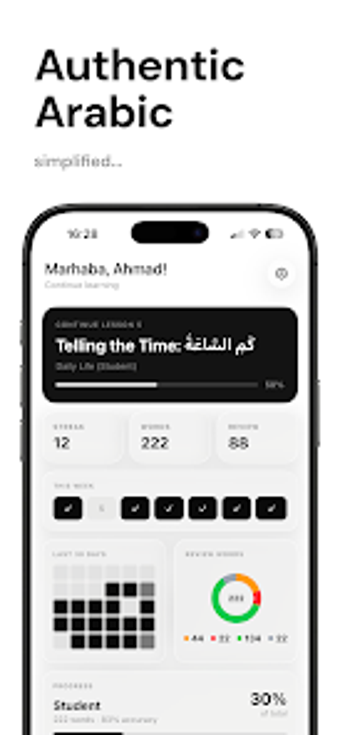
marhaba - Learn Arabic: sentence-driven Arabic learning with visual mapping
Visual sentence mapping and root-based lessons teach Arabic by decoding real sentences and grammatical patterns, with six levels that progress from letters to advanced reading. The app, developed by marhaba, integrates vocabulary, grammar chips, and morphology into daily mobile drills and spaced repetition. It targets absolute beginners through intermediate learners who want reading comprehension and pattern recognition rather than isolated word lists, and it supports placement so learners can start at their current level.
What is marhaba used for?
marhaba focuses on reading comprehension by presenting vocabulary inside authentic sentences and exposing the grammar behind them. The app maps sentences with tree diagrams that show how nouns, verbs, and particles connect, and it pairs those diagrams with interactive grammar chips that explain rules for tapped words. Learners move through six structured levels, which model a course-like progression from alphabet basics to advanced reading.
How does its learning method support retention?
The app combines root-based morphology with spaced repetition to surface words and grammar points at optimal intervals. Root-based lessons teach three-letter Arabic roots and patterns so learners can deduce unfamiliar words, while spaced repetition schedules reviews of items before forgetting. This dual approach turns pattern recognition into a study method that emphasizes decoding and graded exposure rather than isolated memorization.
Is it suitable for complete beginners or intermediate students?
marhaba suits a wide skill range because it starts at the alphabet and offers placement options for skipping ahead. Absolute beginners receive alphabet-level content, and intermediate students can begin at higher modules. The presence of visual sentence trees and grammar chips supports learners who benefit from structural explanations, while placement options let users avoid redundant material.
Does the app track progress and encourage daily practice?
Daily practice tools include streaks and progress tracking to support consistent study, and the six-level structure gives a clear path for measuring advancement. Progress tracking records movement through levels and daily activity, which teachers or self-learners can use to set targets. The app requires a modern Android release for best performance on mobile devices.
A focused choice for learners prioritizing reading and morphological insight
marhaba is a practical tool for learners who want to decode Arabic sentences and build root recognition rather than rely on flashcards alone. It fits solo learners and classroom settings where structural explanation matters. One consideration: its mobile focus and visual mapping are pedagogical choices that may not match learners seeking audio-heavy, conversation-first practice.